
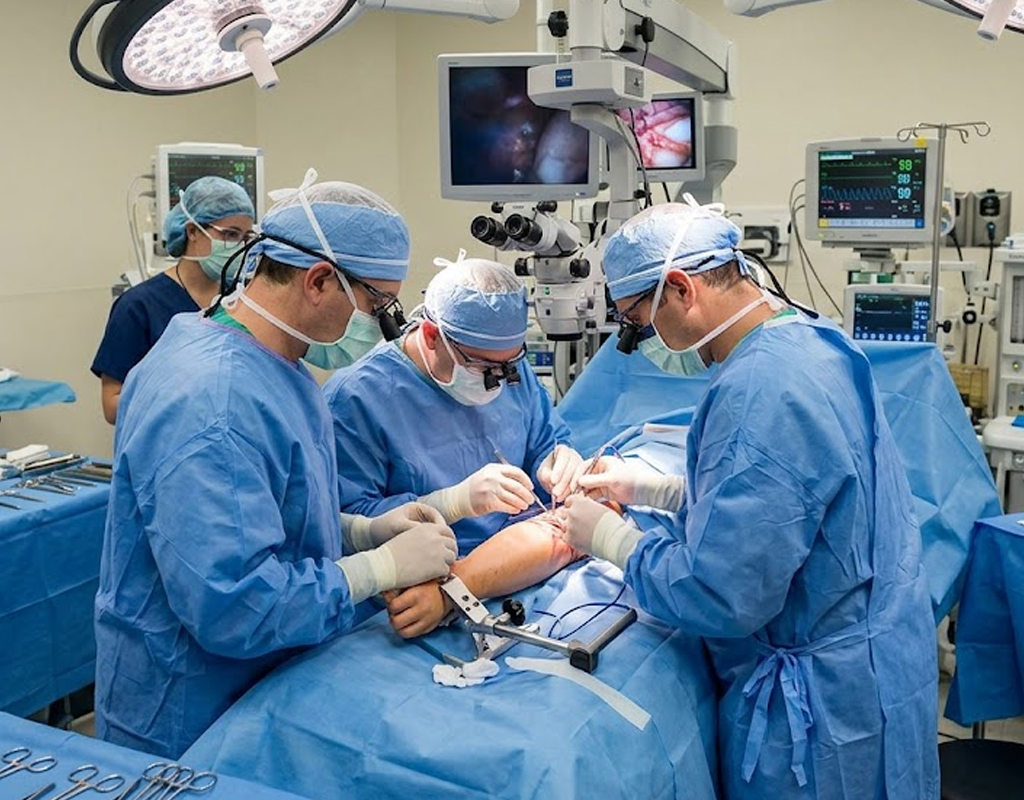
Severe road traffic, industrial, electrical and crush injuries can threaten both life and limb. Dr. Saurabh Gupta provides reconstructive assessment for complex extremity trauma in Jaipur, with a focus on restoring circulation, stable skeletal coverage, soft-tissue healing and useful function. Treatment is individualised and coordinated with orthopaedic, vascular, anaesthesia, critical-care and rehabilitation teams when required.
Limb salvage is a planned sequence of procedures intended to preserve an injured arm or leg when preservation is medically safe and likely to provide useful function. The priority is always resuscitation and control of life-threatening injury. Surgeons then evaluate blood flow, contamination, bone and joint injury, nerve and tendon damage, muscle viability and the amount of missing skin or soft tissue.
Depending on the injury, treatment may include serial debridement, fasciotomy, vascular repair or bypass, tendon and nerve repair, skin grafting, local or regional flaps, free-tissue transfer, bone reconstruction and staged functional reconstruction. Microsurgical free flaps can bring healthy vascularised tissue to cover exposed bone, vessels, nerves or implants.
Not every severely injured limb can or should be salvaged. The decision considers the patient’s overall condition, warm ischaemia time, tissue viability, infection, neurological injury, expected function, rehabilitation burden and the risks of repeated surgery. When amputation offers the safer or more functional outcome, that possibility is discussed honestly.
Limb salvage is a process rather than a single operation. Wound surveillance, fracture care, thrombosis prevention when indicated, physiotherapy, splinting, occupational therapy and later revision procedures may all be needed. Recovery time varies with the original injury and the tissues reconstructed.
copyright © 2026, All rights reserved | Dr Saurabh Gupta