
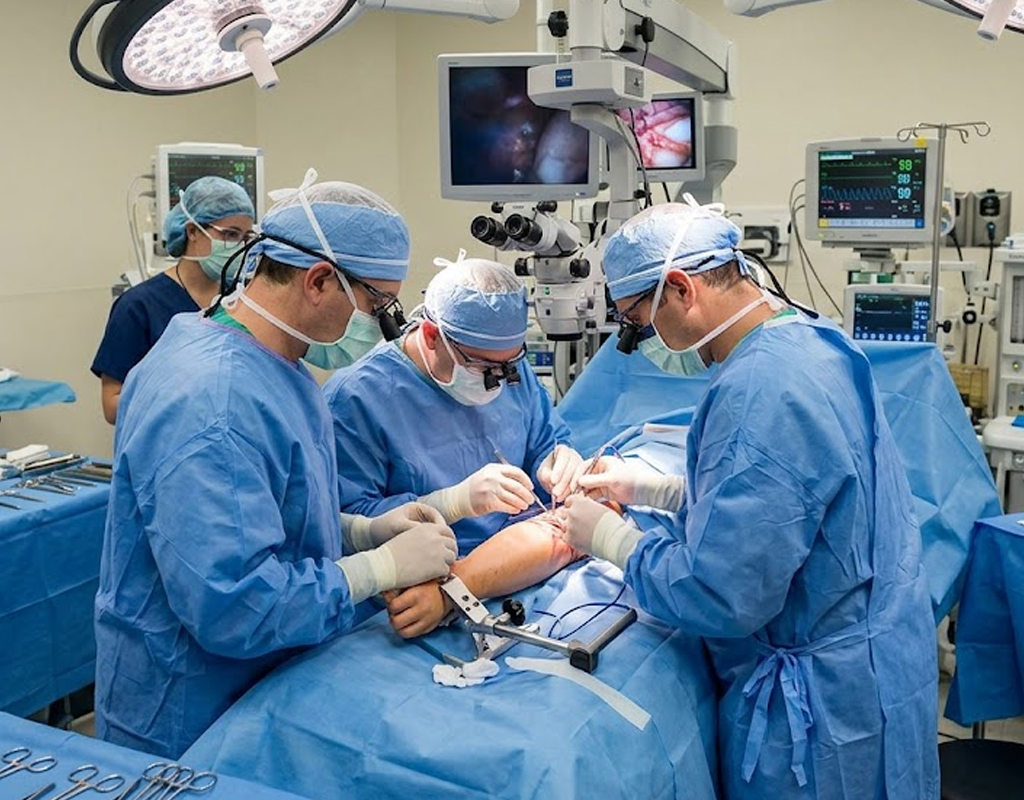
A hand transplant transfers donor skin, bone, muscles, tendons, nerves and blood vessels as a functional unit. Unlike life-saving solid-organ transplantation, it is a quality-of-life procedure that carries lifelong medical responsibilities. Evaluation should occur only through a legally authorised transplant hospital with a dedicated multidisciplinary team.
Programs generally consider carefully selected adults with major hand or upper-limb loss, often bilateral, when conventional reconstruction and prosthetic options cannot meet the patient’s functional goals. Candidacy depends on overall health, limb level, nerve condition, psychosocial readiness, adherence, rehabilitation potential and ability to accept lifelong immunosuppression.
The surgical team connects donor bones, tendons, arteries, veins, nerves and skin in a planned sequence. Recovery requires close monitoring for vascular compromise, infection and rejection. Nerve regeneration and cortical adaptation take time, and functional improvement depends heavily on structured rehabilitation.
Important risks include acute or chronic rejection, infection, medication toxicity, metabolic complications and increased long-term malignancy risk. Immunosuppressive medicines and transplant follow-up are generally lifelong. A transplant can fail and may require removal.
Depending on the level of loss, alternatives may include revision surgery, targeted tendon or nerve reconstruction, toe-to-hand transfer for selected defects, sensate soft-tissue reconstruction, prosthetic fitting and rehabilitation. These options should be discussed before transplant referral.
copyright © 2026, All rights reserved | Dr Saurabh Gupta